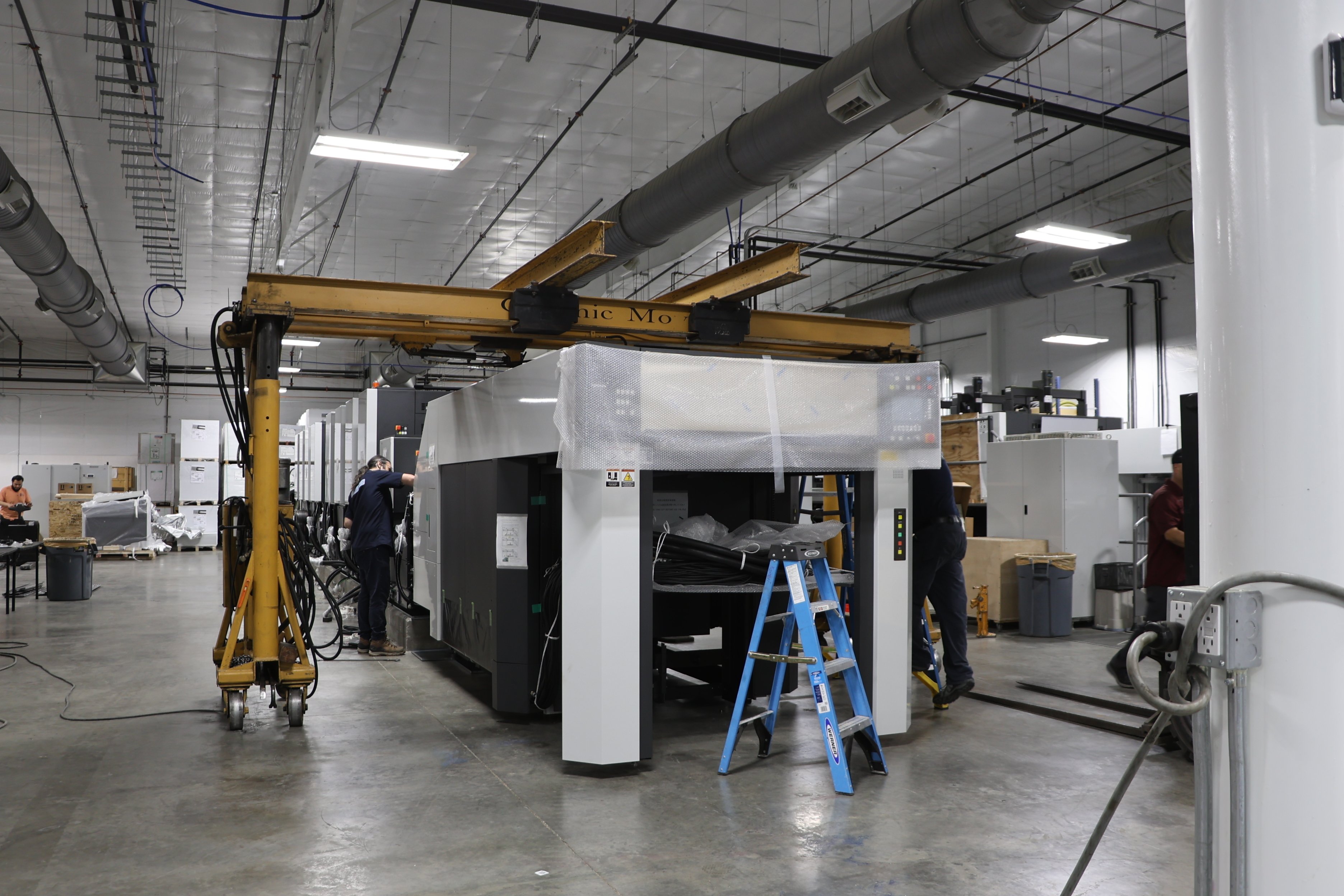
Some industries slow down. Some companies slow down with them. Slate Group missed that meeting. Over the past seven years, the Lubbock, Texas commercial printer has done the opposite: more employees, more equipment, more capabilities, and now a second Komori GL840 perfecting press being installed as you read this."
In 2019, Slate Group was operating out of roughly 40,000 square feet in Lubbock, Texas, with about 60 to 70 employees and a growing appetite for what print could become. Seven years later, the company has 150 employees, 100,000 square feet of production space, and a press room that just welcomed its second Komori GL840 eight-color perfecting press, this one equipped with an inline coater, currently being installed.
“You see, print’s not dying,” said Trey Laverty of Slate Group. “It’s going the other direction.”
Timelapse of 2nd Komori GL840 Press
The Evolution of a Print Operation
Slate Group’s equipment journey reads like a deliberate case study in building toward capability. The company started with two half-sheet presses, capable but limited in scope. Then came a pivotal decision: invest in 40-inch offset printing. In 2019, Slate Group installed its first Komori GL540, a 40-inch, 5-color straight press, and added a second 40-inch press shortly after. The half-sheet presses were retired. A new era had begun.
Two years ago, Slate Group took its most significant leap yet: a Komori GL840 eight-color perfecting press, along with a new 50,000-square-foot building addition to house it. The perfecting configuration, printing on both sides of a sheet in a single pass, transformed throughput and opened the door to publication work, booklets, and complex multi-page projects at a speed the previous setup simply could not match. Notably, when the concrete was poured for the new building, leadership made sure the slab could support a second press. They were not sure when they would need it. As it turned out: two years.
The second GL840, now being installed, adds an inline coater, a capability that feeds directly into one of Slate Group’s fastest-growing service areas. Together, the two presses will allow simultaneous press checks on separate jobs, doubling the efficiency of client approvals and dramatically compressing production timelines. One of the original 40-inch straight presses is being sold; the other remains as a flexible option for mid-range work.
The Diversification Advantage
Ask Trey Laverty what sets Slate Group apart, and diversification comes up fast. The company has systematically brought capabilities in-house that most print shops send out: foil and cold foil, spot UV, velvet laminate, grit laminate, die cutting, screen printing, embroidery, direct-to-fabric, labels, wide format, and a full mailing operation with inkjet addressing and USPS-grade polywrap.
The result is an operation that can move a job from concept through design, press, finishing, and into the mail in days, not weeks. More importantly, it means Slate Group can reach customers across industries and revenue streams, providing real resilience when any one segment softens.
“A lot of people pigeonholed themselves into one industry,” Laverty observed, pointing to businesses that struggled or failed when COVID disrupted their single market. “We’re pretty diversified, and I think being diversified has helped us be sustainable throughout the years and continue growth.”
That diversification extends to how the company thinks about its workforce. Lubbock is not a city with a deep bench of experienced press operators to recruit from, so Slate Group built its own. The average age of their press staff is in the mid-30s, remarkable in an industry often struggling to attract young talent. Press helpers work their way up through cross-training, developing skills across multiple pieces of equipment. The lead operator on the GL840 started on the 5-color press and is now in his mid-30s, running the most complex equipment on the floor.
“We have to find people with the right personality, the right work drive, and put them in the right places and let them thrive,” Laverty said.
Sensory Marketing and the Embellishment Edge
One of the most distinctive threads in Slate Group’s growth story is their embrace of what they call sensory marketing: print pieces designed to be touched, felt, and remembered. Grit laminate that mimics sand. Velvet laminate soft enough to stop a conversation. Holographic cold foil. Raised UV in a single pass. Combinations of effects on a single piece that make recipients question what they are holding.
The inline coater on the new GL840 is a direct extension of this philosophy. A significant portion of Slate Group’s work involves coated applications, and having coating capability on-press, rather than as a separate finishing step, accelerates turnaround and expands what is achievable in a single production run.
The sales approach reflects the same creativity. Slate Group reps routinely produce sample pieces to show clients what their work could look like with a different finish, not as a hard sell, but as a genuine demonstration of what is possible. The response has been consistent: once clients hold a piece with spot UV or feel grit laminate for the first time, reorders follow.
“You don’t know what you don’t know,” Laverty noted. “Once people have it in their hands, they want it.”
Print Inspired: Building an Industry Event from Scratch
When Slate Group installed its first 40-inch Komori press in 2019, they wanted to do more than host an open house. The result was Print Inspired, a one-day event designed for creatives, marketers, designers, photographers, videographers, and anyone who cares about how ideas become physical things.
Now in its seventh year, Print Inspired has outgrown its original format. Last year, 200 people filled the conference space at a hotel across the street from Slate Group’s facility. This year’s event sold out almost immediately, leaving a waiting list of over 40 people. Attendees traveled from Montana, Wyoming, Kansas City, Dallas, East Texas, and McAllen, an 11-hour drive. Laverty is already planning to expand it to a two-day format next year.
What makes Print Inspired different is what it is not. It is not a print industry trade show. It is not a sales pitch with equipment on the floor and brochures at the door. Print comes up for maybe 5% of the day. The rest is creative talks, hands-on workshops, and the kind of cross-disciplinary conversation that print buyers, designers, and content creators rarely get in the same room.
Past conferences featured the designer behind Southwest Airlines’ new livery, who led attendees through designing their own branded plane using wide-format printed PVC boards. Speakers addressed color psychology and team dynamics, AI’s impact on creative work, and the craft of poster and T-shirt design. Workshops gave every attendee a blank shirt and markers, with the winning T-shirt design screen-printed live on-site during the event. The swag bag, loaded with embellished samples and products from event sponsors, typically exceeds the value of the $90 ticket.
This year, as Slate Group installs its second GL840, the new press will feature prominently in the event’s open house component, where attendees cross the street and see the full facility in action: equipment vendors, promotional product and label partners, and speakers signing books. The catwalk above the eight-color presses has become something of a signature tour moment.
"We created Print Inspired based on the open house intended to reveal our first 40” press,” Laverty said. “And it’s kind of special, that’s what started it as we reveal our fourth 40” Komori press seven years later.”
What Comes Next
With two GL840 perfecting presses running side by side, Slate Group is positioned for the kind of publication and high-volume commercial work that increasingly requires speed, quality, and in-house finishing under one roof. Packaging is on the horizon as a potential next chapter, as the GL840 is well-suited for heavier stock, but the current focus is on executing at the level the new capacity makes possible.
The print industry’s future, in this telling, does not belong to the job shop. It belongs to the printer that can do everything, do it fast, make it beautiful, and make the people who receive it feel something.
Slate Group is betting, in concrete and ink and eight-color presses, that they are that printer.